Shop Honey 🛒
About Us

Different Journeys. One Shared Purpose.

SeaBees did not begin with three people following the same path.

It began with three people whose paths were very different.

The People Behind the Mission

Different Journeys. One Shared Purpose.

One journey led through bees, beekeepers, agriculture, and the remarkable world of the hive.

Another followed sea turtles, conservation, and the communities along the Tamaulipas coast.

And another was shaped by business, entrepreneurship, and the belief that a good idea becomes more powerful when it is given the structure to grow.

Those journeys eventually crossed.

What brought them together was not a business opportunity.

It was a shared belief that things which appear separate can become stronger when they are connected.

Bees and sea turtles.
Commerce and conservation.
People and communities on both sides of the border.

Different experiences. Different strengths. Different perspectives.

One shared purpose.

SeaBees grew from that intersection—and from a question that continues to guide us:

What becomes possible when different worlds find common purpose?

We are still discovering the answer.

And that is where our story begins.

How We Found Each Other

Some Partnerships Are Planned. Others Are Discovered.

SeaBees was not created from a traditional business plan.

There was no conference room where someone placed bees on one side of a whiteboard and sea turtles on the other and decided they belonged together.

The connection was discovered.

It began with people already doing work they cared deeply about.

Beekeepers understood the land, the hive, and a tradition passed from one generation to another.

Conservationists understood the coastline, the sea turtles that return to it, and the responsibility of protecting what cannot protect itself.

And between those worlds was another question:

Could one help strengthen the other?

Honey offered a possibility.

Not simply as a product, but as a bridge.

A way to connect the work of bees and beekeepers with a conservation need along the same broader landscape.

A way for commerce to create resources for conservation.

A way for people who might never meet to become part of the same story.

The more we explored the idea, the less unlikely the connection became.

Because nature had already shown us the principle.

Healthy ecosystems depend upon relationships.
Communities depend upon relationships.
And meaningful conservation does too.

SeaBees began at the intersection of three different journeys and one shared purpose.
That purpose became SeaBees.

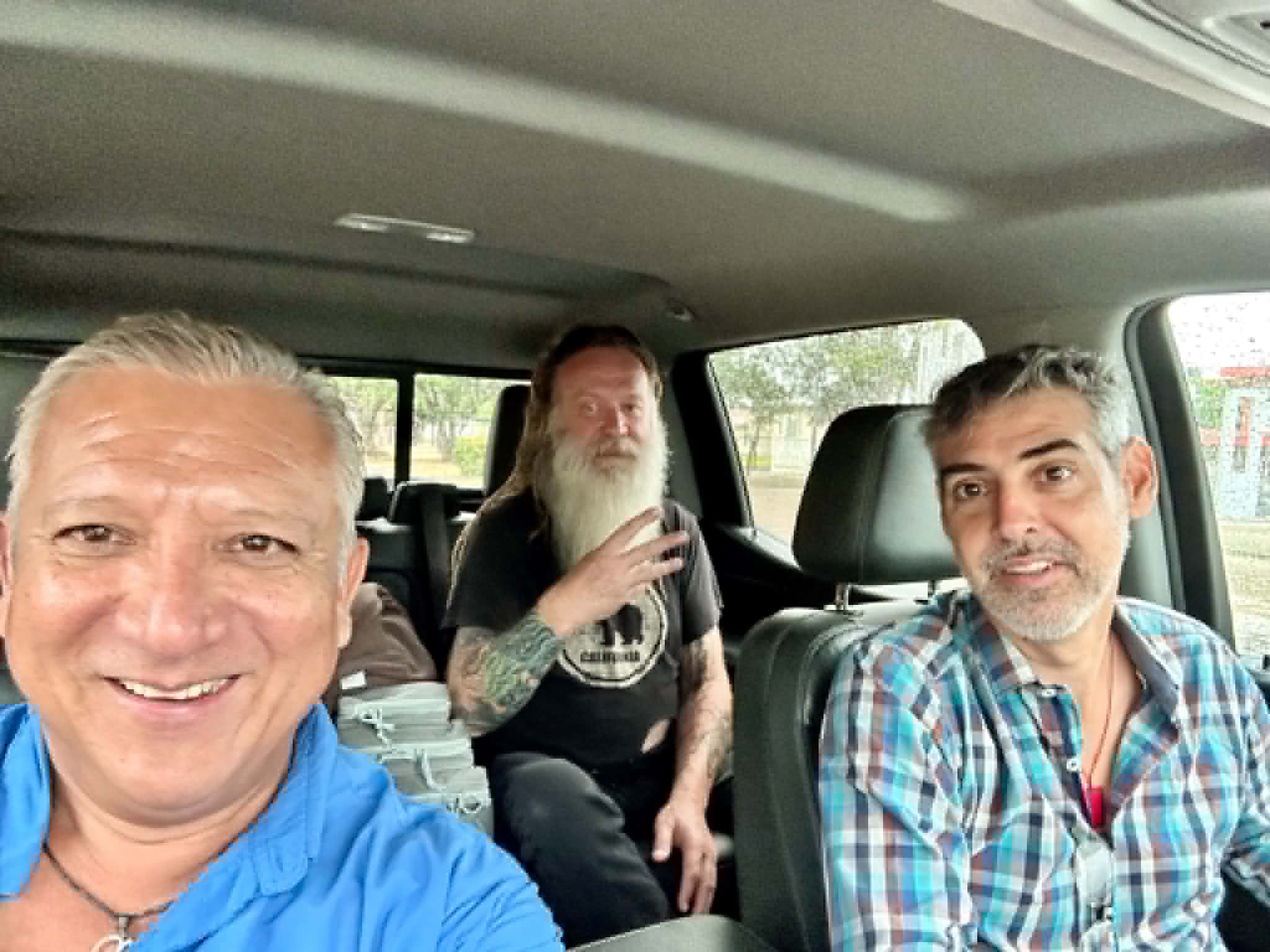
The SeaBees founding team heading into Mexico on their first journey together.
Three different journeys. One road forward.
The SeaBees founding team heading into Mexico on their first journey together.
The Founding Team

No One Builds a Mission Alone.

SeaBees began with three people whose experiences could hardly have been more different.

That difference became one of our greatest strengths.

Each founder arrived with a different perspective, a different body of experience, and a different connection to the mission.

None brought everything SeaBees would need.

Together, they brought the beginnings of something none could have built alone.

The Sea

Skippy

Skippy's path to SeaBees runs along the Tamaulipas coast.

His experience in sea turtle conservation and his relationships with the people and communities doing the work on the ground give SeaBees something that cannot be created from a distance: a connection to the place, the people, and the conservation need itself.

He brings the mission back to where it matters most—the coastline.

To the nests.
To the turtles.
To the people protecting them.
And to the work that still needs to be done.

The Bees

Walter

Walter's world begins with bees.

Through years of work with honey bees, beekeepers, education, and the agricultural community, he brings SeaBees an understanding of the other species at the heart of our story—and of the people whose livelihoods and knowledge are connected to it.

He understands that a hive is more than a source of honey.

It is a living system.

And that protecting bees also means understanding the people, landscapes, and relationships that allow them to thrive.

Walter brings that world into SeaBees—and helps connect the work of the hive to a purpose that can travel all the way to the sea.

The Bridge

Tony

Tony came to SeaBees from another direction.

His background in business and entrepreneurship brought a different question to the conservation challenge:

How do we build something capable of sustaining the mission?

His role has been to help connect ideas with structure—bringing together strategy, relationships, organizational development, commerce, and conservation so that the work happening in the field can be supported by something designed to endure.

The goal is not to make conservation serve the business.

It is to build the business so it can serve conservation.

That distinction sits at the heart of the SeaBees model.

Different Strengths. Shared Responsibility.

The sea.
The bees.
The bridge between them.

Three different perspectives do not mean three different missions.

They mean three different responsibilities to the same one.

Each of us has something to teach.

Each of us has something to learn.

And each of us carries a responsibility to make sure the part we build strengthens the whole.

Because no one builds a mission alone.

We remain students of nature and each other.

The People Around the Mission

A Mission Grows When More People Make It Their Own

SeaBees may have begun with three different journeys.

But it was never meant to end with three people.

From the beginning, the mission has depended upon people willing to bring something of their own to it.

Beekeepers who understand the hive and the land.
Conservationists who know the coastline and the sea turtles that return to it.
Veterinarians and scientists who bring knowledge, experience, and questions that help us learn.
Students and educators who can carry what we discover into another generation.
Communities whose knowledge of their own landscapes cannot be replaced by someone arriving from somewhere else.
Businesses and organizations willing to explore how their resources, experience, or reach might serve a larger purpose.
And people who simply encounter the idea and decide:
I want to be part of this.

Not everyone will contribute in the same way.

They shouldn't.

The strength of SeaBees does not come from asking everyone to bring the same thing.

It comes from creating a place where different strengths can serve the same purpose.

That circle is already growing.

And with every new relationship, SeaBees becomes a little less about the people who started it—and a little more about the people who will carry it forward.

The Mission Is Bigger Than Any One of Us

Our responsibility as founders is not to stand at the center of that circle forever.

It is to help build something strong enough that the circle can continue to widen.

A beekeeper may introduce another producer.
A student may become a scientist.
A scientist may help answer a question we have not learned to ask yet.
A business may open a door.
A community may show us a better way.
A volunteer may become a leader.
And someone we have not met yet may someday make a contribution none of us could have imagined.

That is how a mission becomes larger than its founders.

The circle widens.Knowledge travels.Responsibility is shared.And the mission moves outward.

Like a ripple, we may never know how far it will travel.

Two Countries / One Ecosystem

Countries have borders. Ecosystems do not.

Sea turtles move through shared waters. Bees pollinate landscapes without regard for borders. Rivers, coastlines, weather, agriculture, and wildlife connect communities long before people decide where one country ends and another begins.

SeaBees was born within that reality.

Our journey has taken us across the border between the United States and Mexico, but the mission has never belonged exclusively to either side. The honey produced by beekeepers in Tamaulipas can help create opportunity in Texas. The commerce generated in the United States can help support conservation along the Mexican coastline. Knowledge, relationships, resources, and responsibility can move in both directions.

That is not simply international cooperation.

It is an acknowledgment that we are caring for the same living system.

The people on each side of the border bring different strengths. Beekeepers understand their land and their bees. Conservationists understand the nesting beaches and the turtles that return to them. Veterinarians, researchers, businesses, volunteers, communities, and supporters each see another piece of the larger picture.

SeaBees can help connect those pieces.

Because protecting an ecosystem requires more than protecting a single species or working within a single boundary. It requires people who are willing to look beyond those boundaries and recognize what they share.

Two countries.
Different communities.
Shared waters.
Shared wildlife.
Shared responsibility.
One ecosystem.
How We Work / What We Ask of Ourselves

The Mission Comes First.

It is easy to say what you believe.

The harder question is how you behave when those beliefs are tested.

SeaBees is still growing. We will make decisions we have never made before, enter relationships we could not have anticipated, and encounter opportunities we cannot see today.

So we need something stronger than a set of rules.

We need principles that travel with us.

We ask ourselves to listen before assuming we have the answer.
To respect the knowledge of the people already doing the work.
To be transparent about what we know, what we are still learning, and what we have not yet accomplished.
To hold ourselves accountable for the promises we make and the resources entrusted to us.
To grow carefully enough that opportunity never outruns responsibility.
And to remember that collaboration does not require everyone to think alike. It requires people with different experiences to respect what each can contribute.

We Are Still Learning.

The more time we spend with bees, sea turtles, beekeepers, conservationists, scientists, communities, and one another, the more we understand how much there is still to learn.

That is not a weakness.

It is part of the responsibility.

We do not want SeaBees to become an organization that arrives with all the answers.

We want to ask better questions.

We want to listen.

We want to learn from experience, from evidence, from mistakes, and from the people whose knowledge comes from years spent doing the work.

And when better information changes our understanding, we should have the humility to change with it.

Because stewardship is not simply protecting something.

It is accepting responsibility for how we treat what has been placed in our care.

The bees.
The turtles.
The land and the sea.
The relationships we build.
The resources people entrust to us.
And the mission itself.

We remain students of nature and each other.

Where We Are Going

Our Story Is Still Being Written.

There is a temptation, when telling the story of an organization, to speak as though the destination is already known.

Ours is not.

SeaBees has a vision for where we want to go. We believe commerce can become a dependable engine for conservation. We believe the connection between bees, beekeepers, communities, and sea turtles can grow into something meaningful and lasting.

And we believe there is much more ahead.

But belief is not accomplishment.

We are still building.

Relationships are developing. Ideas are being tested. The conservation-through-commerce model is taking shape. Educational and scientific opportunities are being explored. And the long-term vision of helping strengthen sea turtle rescue and rehabilitation capacity along the Tamaulipas coast remains something we must earn through careful, responsible progress.

We do not know exactly how every part of that journey will unfold.

That is all right.

What matters is knowing the direction.

We Know What We Are Building Toward.

We want to build an organization capable of supporting conservation not only when attention is high, but year after year.

We want the purchase of honey and other carefully chosen mission-aligned products to create resources that can travel back toward the places and people doing the conservation work.

We want beekeepers and agricultural communities to benefit from stronger opportunities around the work they already do.

We want students, researchers, veterinarians, conservationists, businesses, volunteers, and communities to find meaningful ways to contribute.

And we want to help move the vision of greater rescue and rehabilitation capacity for sea turtles along the Tamaulipas coast from aspiration toward reality.

None of that happens simply because we write it down.

It happens one relationship, one decision, one lesson, and one responsible step at a time.

There will be opportunities we cannot see yet.
There will be setbacks we cannot predict.
There will be people we have not met who may someday become an important part of this story.

So we will keep building.

Carefully.
Transparently.
Together.

Because for everything that has brought SeaBees this far, perhaps the most important thing to understand about where we are going is this:

We are still at the beginning.
The Story Becomes Ours

This Is Who We Are. The Rest Is What We Build Together.

SeaBees began with three people whose paths crossed around an unlikely idea.

Bees could help save turtles.

At first, that connection seemed almost impossible.

Today, it feels difficult to imagine one without the other.

Because somewhere along the way, the idea became more than bees and turtles.

It became about beekeepers and conservationists.
About communities and coastlines.
About commerce with a purpose.
About two countries connected by one ecosystem.
And about what can happen when people with different experiences decide to carry the same responsibility.

That is the story of SeaBees so far.

But it cannot be the whole story.

The Story Becomes Ours.

If SeaBees succeeds, it will not be because three people had a good idea.

It will be because other people made that idea their own.

A beekeeper who chooses to participate.
A conservationist who shares what years in the field have taught them.
A scientist who asks a better question.
A student who discovers a calling.
A business that decides its success can serve something beyond itself.
A volunteer who gives their time.
A supporter who buys a jar of honey and becomes part of a conservation story happening hundreds of miles away.
A community that welcomes us, teaches us, and helps show us the way forward.

Each becomes another part of the story.

And each makes the mission a little stronger.

We do not know all the people who will someday become part of SeaBees.

We do not know every place this idea will take us.

And we do not know everything we will accomplish together.

We are still at the beginning.

But we know what brought us here.

Different journeys found common purpose.
Bees became connected to turtles.
Commerce became connected to conservation.
Two countries became connected through one ecosystem.
And a small circle of people began to widen.

Now the story belongs to everyone willing to help carry it forward.

This is who we are.
The rest is what we build together.